Although I have already referred to the STOP and Yield markings on the asphalt, in the “pedestrian crossings” chapter, I think this topic should be emphasized once again because it is the marking that can make the difference between safety and an accident.
Vertical signaling can be unnoticed by drivers in case:
a car drives parallel to a higher vehicle that blocks the driver’s visibility,
the sun is at sunrise or sunset and blinds the driver,
vegetation blocks the visibility of the traffic sign,
weather conditions of rain, snow or fog make the distinction of traffic signs much more difficult through a windshield affected by rain, snow, dense fog.
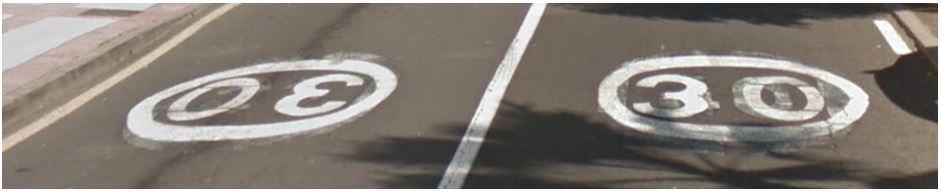
At the same time, the signs with the maximum speed limits should be compulsorily doubled by markings on the asphalt.
In this way, the driver’s attention is drawn in a positive way, to the speed limit that he must respect, especially when he is overtaking, driving in the left lane and in the right lane there is a higher vehicle and he cannot see the vertical sign, vegetation, or the sun prevent him from seeing the speed limit sign.
This should be a mandatory rule for all signatory states to international road traffic conventions.
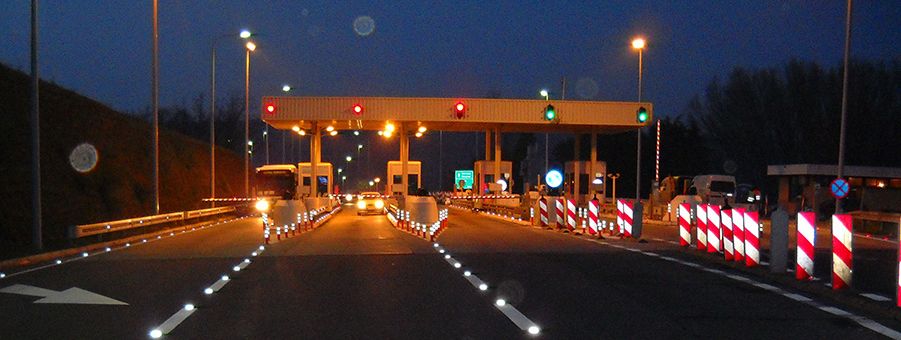
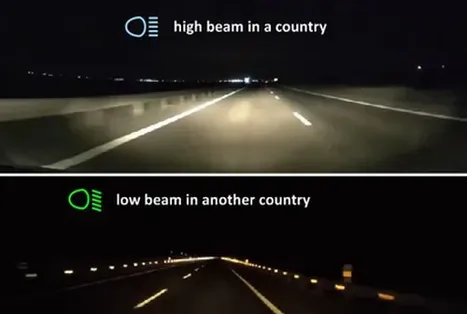
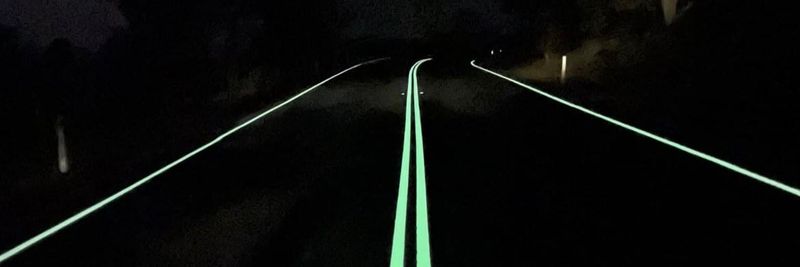
2. The reflectivity of markings
is a very important element for traffic safety.
Unfortunately reflectivity rules and standards differ from state to state, if it exist, and the differences are astronomical.
For example, Romania does not have reflectivity standards for road markings and signs, but there are some instructions from the National Company of Highways and National Roads, which provide for reflectivity coefficients (mcd*m²*lx) for new markings, lower than for used markings from other states. Although the Traffic Police is responsible for authorizing and checking road signs, it does not have any reflectometer to measure the reflectivity of road markings and signs.
And these instructions of the National Highways Company are only applicable in theory and only for national highways and roads. For the other categories of roads, there is no standards, and the administrators of these roads apply paint without any retroreflectivity, because it is cheaper. However, road markings are completely missing on more than half of the roads in Romania, Bulgaria, but also in other Eastern European countries, and reflective elements such as reflective roadside posts, reflective plates on road or bridge parapets, reflective inserts on side road markings are not even known to some states.
Bad or missing road signalization are responsible for more than half of road accidents. In many cases, the authorities ignore the human factor. Man is not a machine, and as machines also make mistakes, road signalization must have the role of prevention.
Road signalization should be standardized with minimum and mandatory elements for all signatory states to international conventions on public road traffic, or at least in the European Union, so that road users are safe, and where road administrators do not fulfill their minimum obligations, to be held liable civilly, contraventional or criminally, in case occur of road accidents.
The bottom line is that in states where the rule of law is in question, corruption makes it possible for these markings not to be made to the detriment of those using the public road, without anyone being held accountable for the mismanagement of resources that should be allocated to road maintenance and the accidents that they occur as a result of bad signaling. As an example, in Romania alone, over 2,000 people die annually, in a real population of approximately 12-13 million inhabitants, over 8,000 people are seriously injured in road accidents, and more than half of the number of road accidents are due of bad road signalization.