
Entry and exit lanes, in and out of the highway
The highway is the place where traffic accidents are the most serious, due to the speed at which they occur.
Highway architecture must provide minimum safety features. However, I have come across many poorly designed highways, approved by those who should have refused the implementation of these projects, because they are real traffic safety bombs.
Acceleration lanes never should overlap on deceleration lanes and their length should allow any vehicle that has the right to travel on the highway to reach the minimum speed to enter the highway speed lane without risk, or to decelerate in safety until entering the traffic in the vicinity of the highway.
1. Length of acceleration and deceleration lanes
For example, the Canary Islands, the 5th tourist destination worldwide, visited annually by tens of millions of tourists, do not expect the surprises they will discover.
In this Google Map capture

it can be seen that the highway exit and deceleration lane intersects with a highway entrance, after which the deceleration lane overlaps with the acceleration lane. In other words, those who exit will brake in front of those who need to accelerate.
And at the end, the common acceleration and deceleration lane bifurcates into two short lanes, which cannot hold a heavy traffic, neither for those exiting nor for those entering the highway.

The deceleration lane (right) has the sign and marking Stop, to give priority to another entrance to the highway, and the acceleration lane (left) is blocked by bollards that do not allow further acceleration and do not overlap with the next entrance into the highway.
At the end of the acceleration lane (left lane), the vehicle that failed to reach cruising speed (in 50 meters), or that cannot enter the freeway speed lane due to vehicles in the first lane of the freeway, is forced to brake and possibly stop.
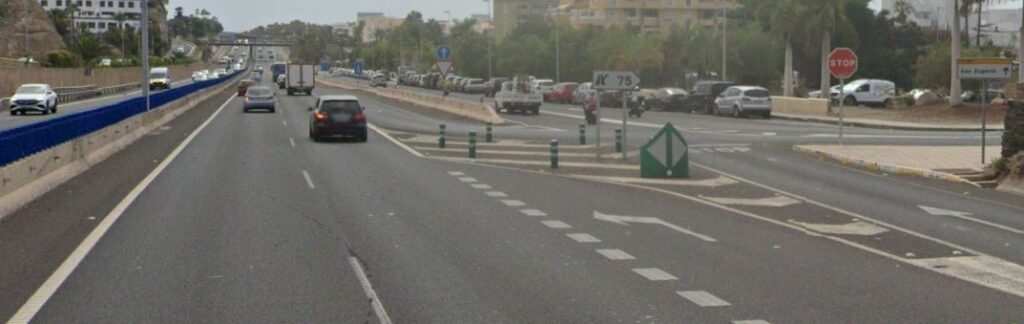
Thus, entering the highway will not be possible at the cruising speed, but starting from zero and entering the path of vehicles in the speed lane, which travel at speeds between 80 km/h (trucks) and 120 km/h (cars). I think it is obvious to anyone that this situation is not even remotely in the spirit of the concept of road safety. Those in the highway speed lane will find themselves with obstacles they cannot avoid, because they do not have enough time, reaction distance, or effective braking distance (which is influenced by the type and weight of the vehicle), to brake on time and safely. Moreover, the vehicles behind will face an even more difficult situation if the distance between the vehicles from speed lane is not large enough.
This acceleration lane have only 113 meters long, but there are many other ramps that are only 100 meters long, or less.

Acceleration and/or deceleration lanes of highways must be long enough to allow all vehicles permitted to travel on highways, to reach the cruising speed of the highway speed lane, and their length should be at least twice the distance required for a low-powered truck, loaded to maximum capacity, to reach cruising speed.
In this way, the necessary distance must be ensured for a truck to be able to achieve the start from 0 and run to 80 km/h – the cruising speed of the first lane of the highway, and then at least the same distance to ensure the safe entry of the vehicle in the speed lane, between 2 vehicles that are in line.
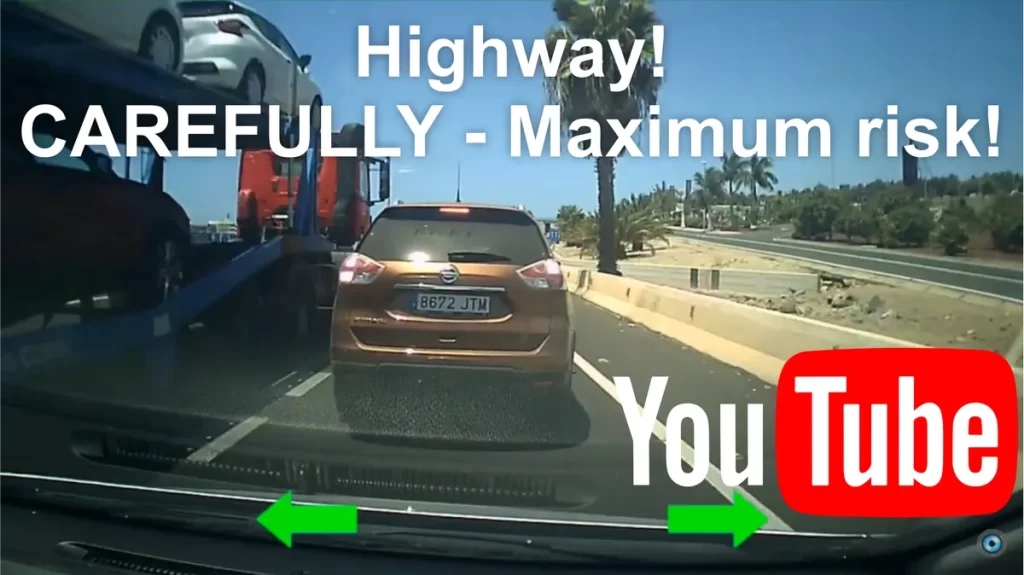
2. Common acceleration/deceleration lanes
Shared acceleration and deceleration lanes were most common at the cloverleaf junctions, which have shown through time use to be the solutions that produce conflicts between engaged vehicles, traffic jams and often accidents. These shared lanes are also found where the authorities have decided that it is necessary to connect a small community to the highway, and the solution of the shared acceleration/deceleration lane was the solution with the lowest costs.
When we talk about safety, life or health of people, the costs should be weighed better.

As can be seen in the image, those exiting the highway intersect and conflict with those entering the highway. Those exiting will brake in front of those entering, who must accelerate to reach the cruising speed of the highway speed lane. Those in the speed lane will have to brake behind those entering the speed lane at a lower speed.
There is already an article on Wikipedia that points out the design flaws of this model, and at the end of the article are presented in a separate link, the solutions that the United States authorities have chosen to fix these design flaws.
However, in many places we find common acceleration/deceleration lanes, the Canary Islands are one of these places where the authorities have allowed this because there is no centralized management to study and to aprove the solutions proposed by the road administrators. From what I have found out, the approval of projects and road signalization is done by different officials from town halls, or local councils, by people without skills in this very important field of road safety.
In Romania, the country with the most accidents and victims (dead and injured) in the European Union, far from the average of the Union, the approval of construction and road signaling projects is theoretically done by the traffic police, but in practice we encounter hallucinating solutions that show the source of statistical figures. Romania is now discovering the economic advantages of highways, as several highways are under construction, each of which contains very dangerous elements, because neither the authorities nor the drivers who have not had the opportunity to drive abroad, have basic information about traffic on highways.
From the website of an NGO that monitors the road infrastructure, I discovered that the ring highway of the capital Bucharest has 4 cloverleaf junctions that will generate conflicts, traffic jams and accidents, but no one seems to be interested in fixing the problems that I have signaled.
MAXIMUM RISK of traffic jams and ACCIDENTS! All these road junctions are of clover type.
A3 with A0 A2 with A0 A0 with DN4 A0 with A1 The node DN7 with A0: fluency problems in DN7 when accessing A0
These accident-generating projects are financed by European funds. For these reasons, I believe that European funding should only be granted to safe projects, which do not endanger traffic safety, and I believe that it is imperative that before such funding is approved, the projects are approved by experts with experience in road safety within European Commission, or individual experts who could be accredited by the European Commission.