In the case of a classic intersection of two roads, each with two lanes, the traffic would be completely blocked at high traffic volumes.
The heavily trafficked main road would completely block access for vehicles from the secondary road.
Therefore, the classic solution for streamlining the intersection is the use of traffic lights.
Let’s assume a complete traffic light cycle is 1 minute: 24 seconds for the green light for one axis + 6 seconds for the yellow light, resulting in 30 seconds for one axis.
With another 30 seconds for the other axis (24 seconds for the green light + 6 seconds for the yellow light), we consider the cycle complete.
In ideal conditions, each lane can allow one vehicle to pass every 2 seconds.
In a 24-second green light cycle per axis, each lane will allow 12 vehicles to pass through the intersection. 12 vehicles/lane X 4 lanes = 48 vehicles/axis
This means that the two axes can ensure a flow of 96 vehicles per cycle or per minute, which can pass through the intersection.
48 vehicles/axis X 2 axes = 96 vehicles/cycle (minute)
This means that a traffic lighted intersection with 2 lanes per direction can ensure a traffic flow of 5,760 vehicles per hour in ideal conditions and without left turns!
96 vehicles/cycle (minute) X 60 minutes = 5,760 vehicles/hour
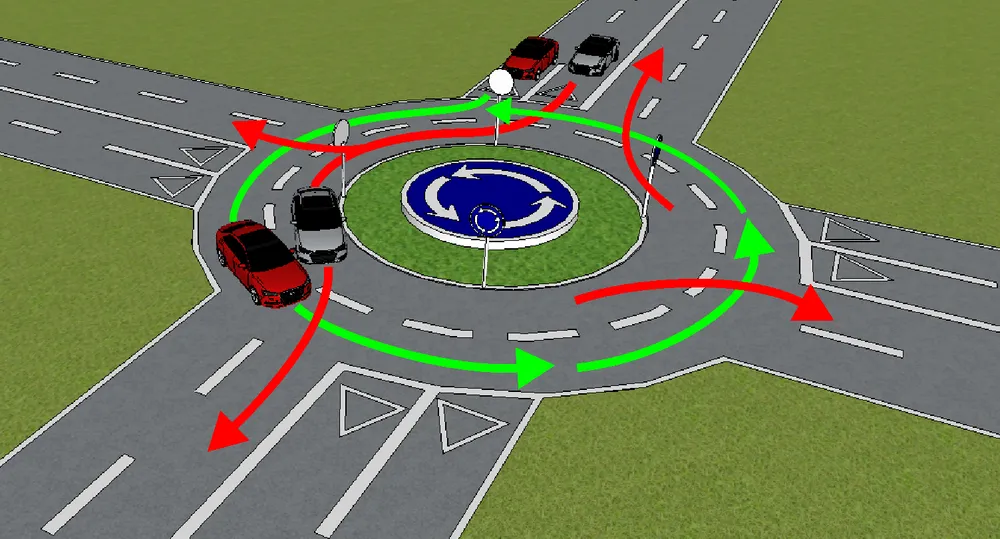
Roundabouts eliminate traffic lights and left turns, but roundabouts also have their limitations. In most countries around the world, traffic in roundabouts is chaotic.
The most common conflicts are between those in the first lane who want to continue circulating and those in the second lane who want to exit the roundabout by turning right. This is totally unacceptable as it affects both traffic flow and, more importantly, traffic safety.
In the USA, some roundabouts are marked in a totally confusing manner, and those in the first lane, who theoretically are supposed to circulate, can be hit by someone exiting the roundabout from the second or third lane.
In countries of the former communist bloc, as well as in many others, roundabouts can have traffic lights both at the entrances and inside the roundabout. Examples include Poland, Hungary, Bulgaria, Romania, etc.
Spain, the paradise of roundabouts, has a better practice for avoiding these conflicts, but here the vast majority of drivers tend to predominantly use the first lane of the roundabout, making the roundabout inefficient.
Of the two entry lanes into the roundabout, the first lane or the outer lane will be predominantly used by drivers, while the second lane (the inner lane) will be used sporadically, increasing the risk of accidents. At high traffic volumes, the slowing down of traffic flows is evident. The first lane, or the outer lane of the roundabout, will be completely occupied, making entry into the roundabout difficult, with long waiting times, sometimes lasting tens of seconds.