According to statistical data, most traffic accidents take place in towns.
Many of them take place at, or near crosswalks, and very many in intersections. Everyone thinks they know everything about crosswalks, their architecture and placement. Unfortunately, most crosswalks in the world are designed and located incorrectly, generating both insecurity and traffic jams, as well as an increased risk of accidents.
At least I have identified 5 problems and solutions to this type of architecture.
1. The danger when crossing the street
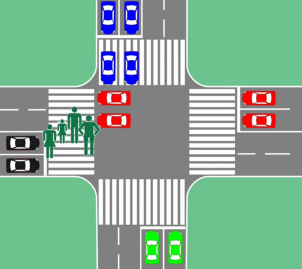
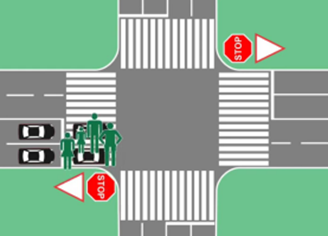
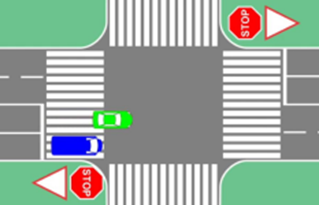
In most states of the world, crosswalks are located at the corner of intersections.
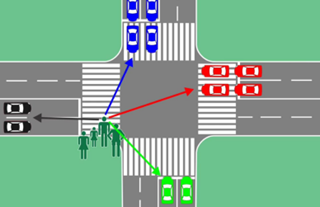
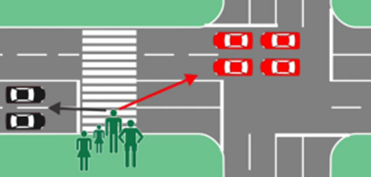
Crossing streets at the corner of intersections, even on crosswalks, requires ensuring pedestrians from four directions: left, right, front and back, and not just left and right, as wrongly formulated in the traffic laws of many states.
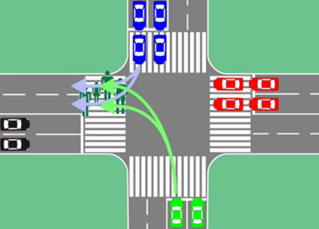
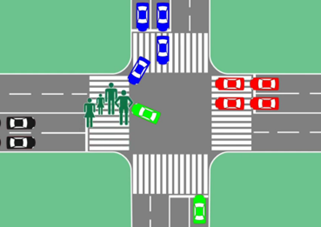
Vehicles traveling on the road parallel to the crosswalk may turn left or right and surprise you crossing the street on the crosswalk.
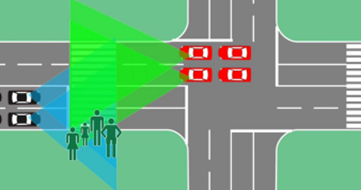
If the drivers of these vehicles are attentive and skilled, there should be no problem, but things can be a bit more complicated for less talented or experienced drivers, because executing a turn involves several operations such as: signaling, insurance from different angles, gear changing, braking and distributed attention, but here comes the problem – visual field and especially peripheral visual field.
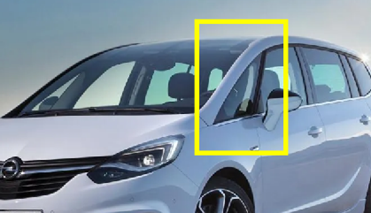
Many vehicles have blind spots at the A-pillars, the pillars between the windshield and the front door glass, which are doubled. This could cause the drivers of these vehicles not to notice the pedestrian in the crosswalk in time, or at all. In the case of these vehicles, the blind spot is approximately 15-25°.
If the speed of the vehicle is not correlated, the accident is already a number in the statistics.
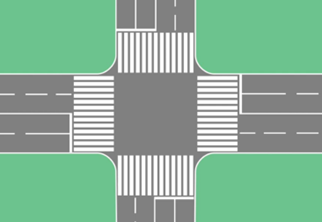
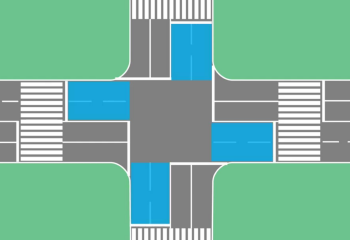
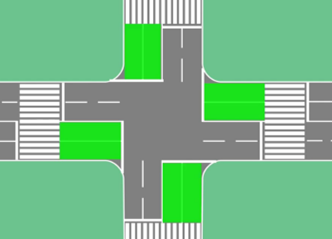
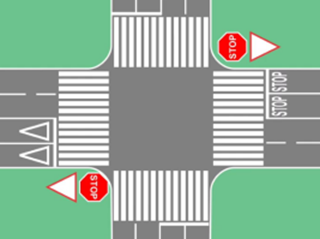
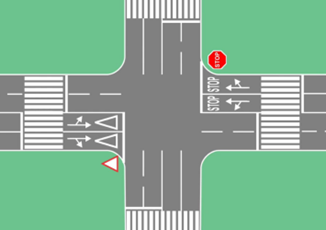
The solution: Crosswalks should never be at the corners of intersections.
Things have a different dynamic and a different perspective if the crosswalks are located some distance from the corners of the intersection.
In this case, pedestrians will only have to secure themselves from the left and right sides.
All drivers of vehicles on this road segment will have in their field of vision, through the windshield, all pedestrians from the crosswalk, or in their proximity.
2. Intersection blocking
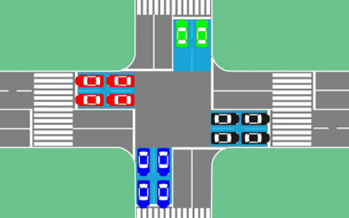
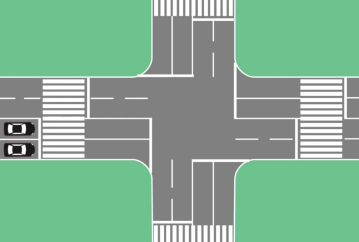
It can often happen that vehicles yielding to pedestrians in the crosswalk or engaged in crossing have to stop in the way of vehicles coming from the side.
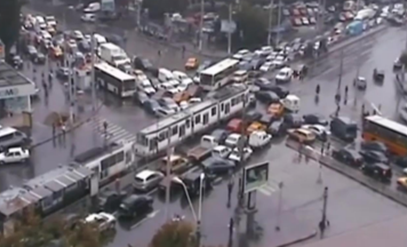
Because we live in a dynamic society and we are all in a hurry, many of the drivers will enter the intersection from the priority or free directions, until the entire intersection is saturated and blocked, but all the adjacent traffic will also be disrupted and blocked, thus reaching to waste several hours a day, stuck in traffic.
This is what happens when you can’t get past the corner of the intersection and are forced to block traffic.
The solution: Crosswalks should never be at the corners of intersections.
If the crosswalks are located some distance from the corners of the intersection, we will create a buffer space for those who want to exit the intersection and must give way to pedestrians on the crosswalk, or who want to engage in crossing.
In this way, vehicles that have crossed the intersection will exit the intersection by entering this buffer space, without unnecessarily blocking the intersection.
3. Intermittent blocking
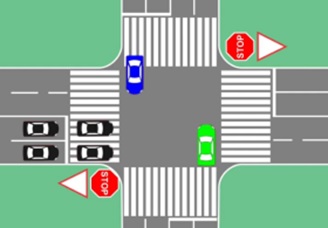
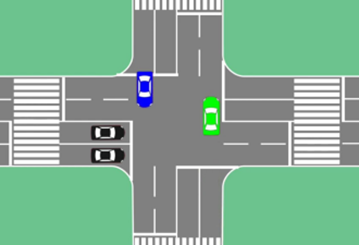
Before entering the intersection there is a pedestrian crossing and you must automatically give way to pedestrians.
After giving priority to pedestrians, you advance to the corner of the intersection for maximum visibility and must give way to vehicles traveling through the intersection on the main road, or priority road.
While you are waiting for vehicles from the priority road to pass through the intersection, other pedestrians may appear who want to cross the street, obviously on the crosswalk. There is a risk of not noticing a distracted and hurrying pedestrian and hitting him when you start to cross the intersection.
The solution: Crosswalks should never be at the corners of intersections.
If crosswalks are located some distance from the corners of the intersection, we will create a buffer space for those who want to enter the intersection and must give priority to vehicles from the main road, or priority road, without conflicts with pedestrians who engage in crossing.
Now, in this situation, you stop at the crosswalk where you give way to pedestrians, after which you move forward in the buffer zone towards the corner of the intersection.
And here, you will give priority of passage only to vehicles on the main road, on the priority road, without entering into conflict with any pedestrian who would like to cross the street. When the intersection is clear, you can continue crossing it without any risk.
In this way we eliminate conflicts, eliminate risks, eliminate possible accidents.
4. The impossibility of applying visible markings
Vertical markings are part of road signage, only their effectiveness is reduced when vehicle traffic is carried out on several lanes, and there are height differences between vehicles in different lanes.
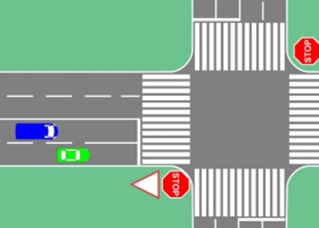
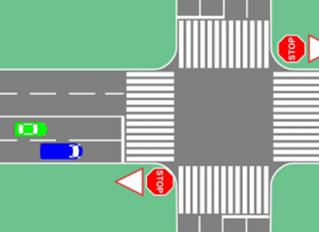
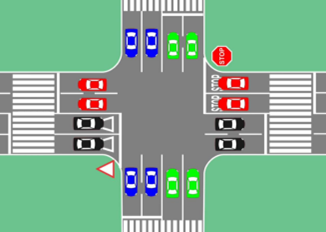
In this situation, in second lane we have a truck, and in first lane we have a car. The height of the truck and its driving position allows the truck driver to see above the height of the car the Stop or Yield sign at the corner of the intersection. But, a truck in the second lane is only in the situation when it intends to turn left in the intersection.
In all other situations, the truck will be in the first lane and the car in the second lane. In this situation, the driver of the car will not be able to see the Stop or Yield sign at the corner of the intersection, due to the fact that he does not have direct visual contact, due to the truck being taller and blocking his visibility.
There is an increased probability that the car will enter the intersection without checking, because it does not see the Stop or Yield sign, nor the truck’s intention to stop at the corner of the intersection, because it does not see the truck’s brake lights.
We also encounter the same situation if the Stop or Yield signs are covered by vegetation, but also if the sun blinds us at sunrise or sunset, during fog, snow or rain, when visibility is low.
In this configuration of crosswalk architecture at the corner of the intersection, the Stop or Yield markings applied to the asphalt before the crosswalks are pointless and do not make sense. Stop and Yield signs are markings that are placed at the intersection and are intended to be seen by vehicle drivers, in order to know what is the priority of passage in relation to other vehicles.
Stop and Yield markings should be mandatory at all intersections, because they are in the field of vision of all drivers and cannot be ignored or overlooked due to natural causes, or if the driver is inattentive, distracted, tired, or under the influence some substances. Prevention should be the primary goal.
The solution: Crosswalks should never be at the corners of intersections.
If the crosswalks are located at some distance from the corners of the intersection, in the buffer space created between the crosswalk and the corner of the intersection, both directional markings and Stop or Yield markings can be applied. In this way, no driver will be able to miss the meaning of the obligation to stop or give way.
What is the optimal distance for the placement of crosswalks?
Based on measured or known traffic flows, the buffer zone between the corner of the intersection and the crosswalk should be a minimum of 6 meters for low traffic, so that this zone can accommodate at least one car per lane.
For heavy traffic flows, where buses or other long vehicles frequently travel, the buffer zone between the corner of the intersection and the crosswalk should be at least 10-20 meters, so that this zone can accommodate at least two cars per lane and /or at least a bus.
5. Geometry of crosswalks, solution for excessive speed
Excessive speed is another major cause of traffic accidents!
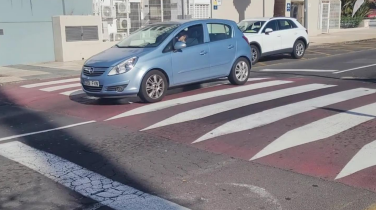
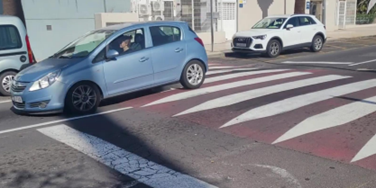
Crosswalks can be the solution to speeding traffic, without speed cameras, without cameras, without cops, without the stress of fines. The Canary Islands are the best example, having the best crosswalk architecture in the world.
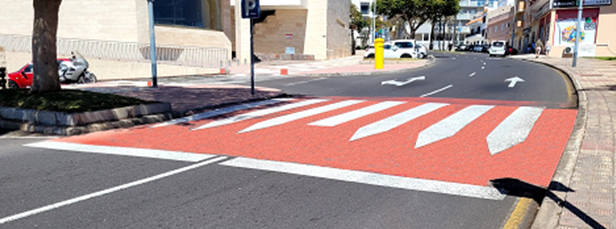
Speed reducers, or raised crosswalks, are the solution that forces drivers to reduce their speed to the speed limits imposed by the road administrator.
The best-known and most common solution are speed limiters made of rubber, plastic or concrete, with small widths, which do nothing but destroy the joints of the cars. The rolling surface on this device is so small that the damping assembly consisting of the tire, the spring and the telescope of the car’s joint, have to endure a hard, fast and short compression, upon entering the surface of the speed limiter, decompression when the wheel reaches the crest, when following the slope and the second compression when the wheel reaches the road side again.
All this happens in a fraction of a second, given that:
At 30 km/h, a vehicle travels 8.33 m/sec.
At 10 km/h, a vehicle travels 2.78 m/sec.
And the width of the limiter, the length traveled by a vehicle over it, is only ~40 cm.
The effect felt by both vehicle occupants and the mechanics of the car relatively the same at both 30 km/h and 70-100 km/h. This speed limiter model will not intimidate or deter on speed-men.
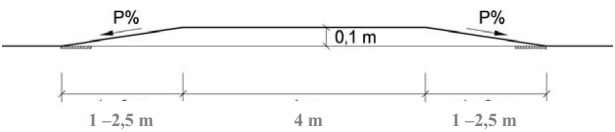
Unlike these speed limiters, joint and suspension destroyers, raised crosswalks are the comfortable solution for those who obey the posted speed limit, and can be very expensive for those who step on the gas pedal too hard. The angles of attack and clearance can be calculated differently, for different speed limits, and their length (6-10 m) makes it possible to pass smoothly, without negative effects on the suspension or joints of the car.
In the first part of the crosswalk, vehicles will encounter a ramp with a length of 1 – 2.5 meters.
The top of the crosswalk has a minimum length of 4 – 6 meters.
And the exit slope from the crosswalk will also have a length of 1 – 2.5 meters.
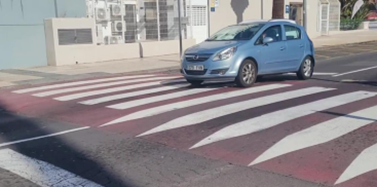
At the speed imposed by signs and/or markings, a vehicle passing over these elevated crosswalks will barely feel the bump;
At a speed 10 km/h above the speed limit, the vehicle and its passengers will feel the bump slightly;
At a speed 20 km/h above the speed limit, the vehicle and its passengers will feel the bump quite hard;
At a speed 30 km/h above the speed limit, the occupants of the vehicle will feel the bump very violently and the vehicle may be damaged;
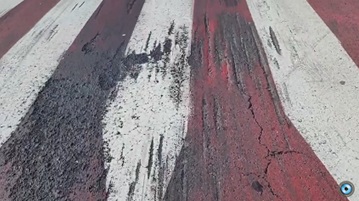
This is the only crosswalk violated by a few hurried tourists that I saw in Tenerife.
A busted bumper, radiator, or busted oil pan will definitely keep speedmen from stepping on the gas in the future.
At the same time, this type of crosswalk makes it possible for it to be easily accessed by disabled people in wheelchairs, the crosswalk being at the level of the pavement.
The role of speed reducers is to maintain a speed that should have already been reduced by other measures (for example: signaling, roundabout, etc.).
To achieve the desired efficiency, the distance between consecutive speed reducers must be between 50 and 200 m, although the recommendation is not to exceed 150 m between 2 such crosswalks.
Unfortunately, the web format allows me to put the video link only from the beginning. For English, watch from 09:12 until the end. For Español watch from 10:00 hasta el final.
Conclusion
Elevated crosswalks, configured with correct angles of attack and clearance, are the best solution to calm traffic at moderate speeds (30-50 km/h), especially in states where the speed limit is often violated, and speedmen are a real danger to traffic safety.